What Carefully Staged Strikes Reveal About American Values
Sunday, January 4, 2026
President Trump's pattern of precisely timed military operations—from Christmas Day strikes branded as 'presents' to missions named after fallen soldiers' home states—reveals a troubling prioritization of political optics over strategic necessity, raising questions about whether such actions serve national security or merely project an image of strength.
# The Political Theater of Military Might: What Trump's Carefully Staged Strikes Reveal About American Values
When President Donald Trump announced U.S. airstrikes against ISIS targets in Nigeria on Christmas Day 2025, he was candid about the timing. "They were going to do it earlier," Trump told reporters, "And I said, 'nope, let's give a Christmas present.'"
That admission—treating military action as gift-wrapped political theater—exemplifies a disturbing pattern emerging from the Trump administration's foreign policy in 2025. According to data from the Armed Conflict Location & Event Data Project, the U.S. has conducted at least 626 overseas strikes since Trump's January inauguration, surpassing the entire four-year total under his predecessor.
But it's not just the quantity of military action that raises concerns—it's the staging.
## Image Management as Foreign Policy
Operation Hawkeye Strike, launched December 19 to retaliate for the deaths of two U.S. soldiers in Syria, wasn't named for tactical reasons. The designation honored Iowa, the "Hawkeye State" where both fallen servicemembers were from—a detail seemingly designed for maximum emotional resonance with domestic audiences.
Similarly, the Christmas Day Nigeria strikes, which Trump framed as protecting Christians being "mass slaughtered," appeared timed for symbolic impact rather than military urgency. Defense Secretary Pete Hegseth called it a "declaration of vengeance," language more suited to rallying political supporters than explaining strategic necessity.
The pattern extends to Trump's social media communications. At 2:58 a.m. on January 2, 2026, the president posted on Truth Social threatening Iran: "If Iran shots [sic] and violently kills peaceful protesters, which is their custom, the United States of America will come to their rescue. We are locked and loaded and ready to go."
The ungrammatical threat, issued in the pre-dawn hours with no elaboration or specific military plan, functioned primarily as performance—a demonstration of toughness for domestic consumption.
## The Contradictions of 'America First'
These actions stand in stark contrast to Trump's campaign promises. Running on an "America First" platform, he pledged to disentangle the United States from foreign conflicts. At his January 2025 inaugural ball, Trump declared his "proudest legacy will be that of a peacemaker and unifier," measured "by the wars that we end—and perhaps most importantly, the wars we never get into."
Yet the administration has expanded military operations to seven countries: Somalia, Iraq, Yemen, Iran, Syria, Nigeria, and Venezuela. The sustained maritime campaign against alleged drug-trafficking vessels in the Caribbean has killed at least 95 people, according to Human Rights Watch, which accuses Washington of "extrajudicial killings."
Trump describes the Caribbean deployment as the "largest armada ever assembled in the history of South America," promising it will "only get bigger"—rhetoric that emphasizes spectacle over substance.
## The Real Costs of Political Performance
While Trump's carefully choreographed military actions may boost his image as a strong leader among supporters, they carry real-world consequences that extend far beyond political theater.
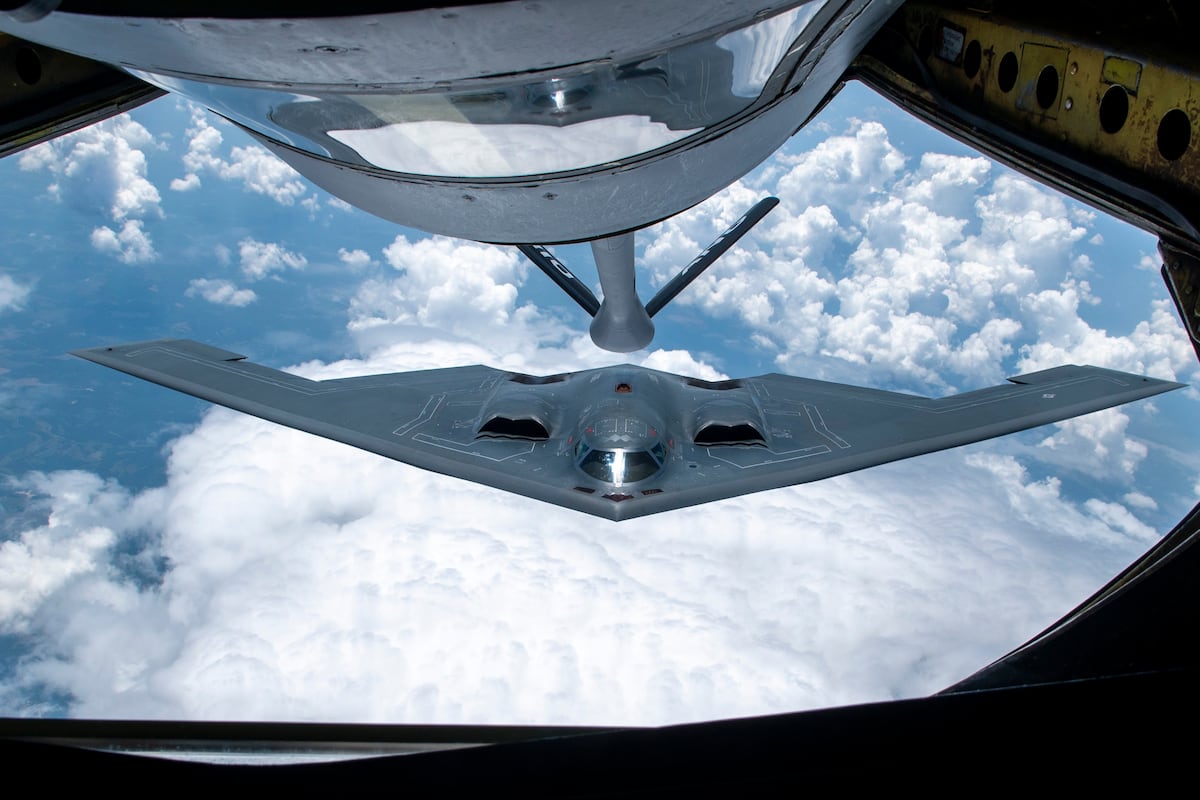
The June 22 strikes on Iranian nuclear facilities—Operation Midnight Hammer—involved seven B-2 stealth bombers dropping 30,000-pound bunker-buster bombs. Trump announced achieving "total obliteration" of Iran's enrichment capabilities in a primetime address, though Tehran disputed that assessment. The Pentagon estimates the strikes set back Iran's nuclear program by approximately two years, but also prompted Iranian threats of regional destabilization.
In Nigeria, the Christmas strikes targeted the newly emerged Lakurawa armed group in Sokoto State, despite the fact that alleged attacks on Christian farmers cited by Trump and Senator Ted Cruz occurred in a completely different region—the central Middle Belt—and involved different circumstances entirely. Nigeria's foreign minister emphasized the strikes had "nothing to do with a particular religion," contradicting Trump's framing designed to appeal to his Christian conservative base.
The December strikes on a Venezuelan docking facility marked the first U.S. attack on Venezuelan land, escalating what journalist Jonathan Chait called a "slow roll to war." White House Chief of Staff Susie Wiles suggested in a candid interview that deposing President Nicolás Maduro might be the actual goal, while Maduro himself theorizes the U.S. seeks Venezuela's oil wealth.
## What Are We Really Worshiping?
The careful staging of these operations—the symbolic dates, the evocative code names, the dramatic 2 a.m. social media threats—suggests that projecting an image of strength has become as important as, or perhaps more important than, achieving actual security objectives.
When military action is timed as a "Christmas present," when operations are named for political resonance rather than tactical purpose, when threats are tweeted in the middle of the night for maximum attention—these choices reveal what's truly being prioritized.
Sarang Shidore, head of Global South at the Quincy Institute for Responsible Statecraft, notes that "Washington's escalated offensive in Latin America and strikes in Nigeria and Somalia are partly performative acts rooted in domestic drivers of foreign policy."
The question Americans must confront is whether they're comfortable with military force—which involves real human lives, substantial financial costs, and long-term geopolitical consequences—being deployed primarily for its value as political messaging.
When the appearance of strength becomes the goal rather than the means, when image management drives foreign policy decisions, what god are we actually serving? The evidence suggests it may not be national security or even American interests, but rather the relentless demands of political theater and the worship of appearing powerful.
As Trump himself admitted about the Nigeria timing: the military was ready to strike earlier, but he chose Christmas Day for the optics. In that moment of candor lies a troubling truth about whose interests are really being served when force becomes performance.