The Invisible Witnesses: Who Else Was Present When Renee Good Was Shot?
Saturday, January 10, 2026
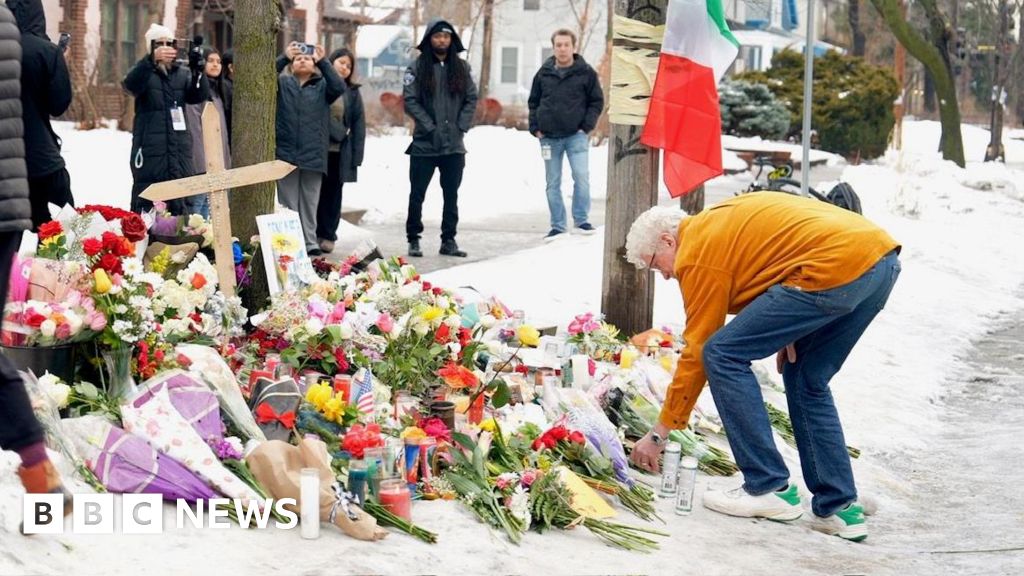
As investigations and protests swirl around the ICE shooting that killed Minneapolis resident Renee Good, the human beings at the center of the incident—the agent who pulled the trigger, the officers who witnessed it, and the immigrants the operation targeted—have all vanished behind policy debates and jurisdictional disputes.
The blood in the snow has a name: Renee Nicole Good, 37-year-old poet and guitarist, wife and mother, "everything that was good about our community," as one Minneapolis neighbor put it. But in the furious debate that has consumed Minnesota and Washington since an ICE agent shot her through her car window, nearly everyone else involved has become invisible.
The agent who fired three shots into Good's SUV remains unnamed in public reports, his face hidden behind a mask in the video footage that has circulated widely. He is present in the controversy only as a policy instrument—either a hero defending himself against a driver accelerating toward him, as Vice President JD Vance claims, or a reckless enforcer of "wide-scale violation of people's rights," depending on which press conference you watched Thursday.
But what do we know about this person? Is he wrestling now with having taken a life? Did he follow his training, or did something go catastrophically wrong in that moment when Good's car began to move? Federal protocols and the machinery of political narrative have rendered him invisible as a human being, visible only as a symbol.
The other ICE agents present at the scene have disappeared even more completely from the conversation. Video shows multiple masked officers approaching Good's vehicle. They were there. They witnessed everything. Some may have questioned the decision to fire in real time but had no authority to intervene. Others may have fully supported their colleague's split-second choice. They will carry this incident with them—in debriefings, perhaps in nightmares, certainly in the muscle memory of future encounters with civilians.
Yet their perspectives, their internal deliberations, their humanity: none of this appears in our public reckoning. We don't know their names. We don't know if they've been placed on leave. We don't know if they're being questioned as part of the FBI investigation that Minnesota officials now claim has excluded them.
And perhaps most invisible of all: the people the operation was actually targeting.
The ICE deployment to Minneapolis was part of the Trump administration's expanded immigration enforcement initiative. As many as 2,000 federal officers have been sent to the city. The administration reports having deported 605,000 people between January 20 and December 10, 2025, with another 1.9 million "voluntarily self-deporting" under pressure.
But what happened to the immigrants ICE was seeking when Renee Good was shot? Were arrests made? Were people detained and transferred to facilities where, according to immigration lawyers, it can take families days to locate them? Or did the shooting abort the operation entirely, sending targets scattering into a community now on edge?
We will likely never learn their names. They exist in official statistics—part of the 65,000 people in ICE detention as of late November, perhaps, or among those who slipped away. Their stories, their families, their fears: all erased by an incident that transformed an immigration enforcement operation into something else entirely.
This erasure creates a dangerous vacuum where partisan narratives rush in uncontested. Governor Tim Walz calls it "a reckless ICE mobilization" and worries that federal control of the investigation will prevent a "fair outcome." Vance insists "what you see is what you get" and dismisses state involvement as unprecedented. Meanwhile, the Minnesota Bureau of Criminal Apprehension, initially tapped for a joint investigation with the FBI, says it was kicked off the case and has "reluctantly withdrawn."
The jurisdictional battle—federal versus state authority, who investigates whom—is a real constitutional question with serious implications. But it also serves to further obscure the human beings whose choices and experiences that day will never fit neatly into either side's narrative.
When protesters gathered at the crash site Thursday, placing candles and roses in the snow still stained with Good's blood, they were doing something the political debate cannot: acknowledging that a specific person died in a specific place. "They cannot get away with killing someone. There has to be consequences for actions," said one protester named Gavin.
But consequences for whom, exactly? For an unnamed agent whose face we've never seen? For a system that deployed 2,000 officers to a city and gave them broad authority to use force? For all of us, who have structured our national conversation about immigration in ways that make it nearly impossible to see the individual human beings—on all sides—whose lives are being permanently altered?
The incident raises uncomfortable questions about truth-telling by officials who have "already passed judgment," as Walz noted. It raises questions about the proper limits of government power and the use of deadly force. But perhaps the most spiritually unsettling question is this: In our rush to claim Renee Good's death for one political narrative or another, how many other people are we rendering invisible?
The agent who pulled the trigger is invisible. His colleagues are invisible. The immigrants they were seeking are invisible. And in that invisibility, we lose something essential: the ability to reckon honestly with what happened and why, to assign responsibility without dehumanizing, to pursue justice without erasing the complexity of the human beings involved.
Until we can see all the people in the frame—not just the ones whose names fit our preferred storyline—we cannot hope to understand what really happened in those seconds when an immigration enforcement operation became a tragedy. And we certainly cannot prevent it from happening again.