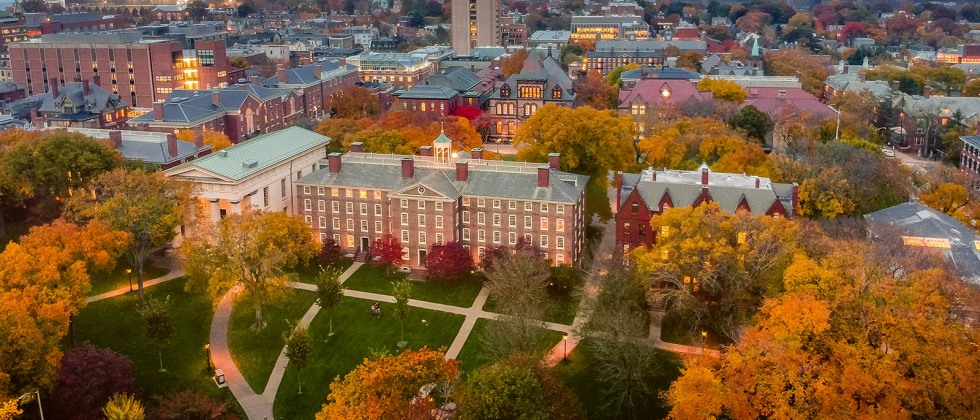
Undergraduate Admission | Brown University · https://admission.brown.edu/visit/campus-tours-and-information-sessions
Forty of 86 Brown economics students taking a course on fairness cheated using AI. A reflection on knowing what's right and choosing otherwise anyway.
I do not understand what I do. For what I want to do I do not do, but what I hate I do.
Romans 7:15-19
In March 2026, Brown University's economics class on social choice theory—a course literally about fairness and how to make just decisions—had its midterm exam. Forty of the 86 students turned in identical answers. Not similar. Identical. The AI they used generated a convoluted proof for a problem that actually has a much simpler solution. Dozens of students submitted the exact same convoluted reasoning.
The professor ran the answers through ChatGPT himself to confirm it. He found the fingerprint of the machine in every suspicious exam.
The cheating stings. But the wound is what they were supposed to be learning. This course teaches welfare economics, social choice theory, the mathematics of fairness. These students sat down to study the conditions that make a system just. They learned about constraints and incentives. They learned how to think about rightness. Then they violated everything they learned the moment it mattered.
When the professor announced the final would be in-person, nearly a third of the class dropped. The remaining students took the final and scored 48% on average. The students knew. They knew what they had done. They knew the difference between understanding justice and living it.
Paul knew this feeling. He says it plainly: "I do not understand what I do. For what I want to do I do not do, but what I hate I do." He confesses something deeper than ignorance: a reckoning. The knowledge is there. The desire to do good is there. And still he does the opposite.
Moral weakness is baked in. But this essay goes deeper. This is about the gap between seeing what's right and doing it. The Pharisees in Jesus's time knew the law. They studied it. They taught it. They could recite it. Jesus said they were like tombs—beautiful on the outside, full of dead bones inside. They knew what justice looked like and chose anyway.
The students at Brown knew. That's the hardest part to sit with.
Knowledge won't fix this. No course corrects it. A stricter code just shifts the lie. Paul knew the law. He knew it better than almost anyone. Knowledge does not save us from ourselves. Only something outside ourselves can do that.